
AI Tools
Feb 19, 2026
Edge Computing Use Cases: The Ultimate 2026 Guide to Real-World Speed & Efficiency Meta
Meta Data
Meta Title: Edge Computing Use Cases: The Ultimate 2026 Guide to Real-World Speed & Efficiency Meta Description: Discover the top Edge computing use cases defining 2026. From autonomous vehicles saving lives to smart factories, precision agriculture, and privacy-first retail, explore the definitive guide to the post-cloud era. Focus Keyword: Edge computing use cases Tags: Edge Computing, Industrial IoT, Artificial Intelligence, Smart Cities, Autonomous Vehicles, Digital Transformation, 2026 Tech Trends, Cloud Computing, 5G, Data Privacy, AgriTech, FinTech
Edge Computing Use Cases: The 2026 Guide to Real-World Speed
Picture a self-driving car traveling at 70 mph on a busy highway. Suddenly, a child runs into the street after a ball. The car’s cameras spot the child. If the car needs to send this video to a server far away, wait for an AI to decide, and then get the command to brake, the whole process takes about 100 milliseconds.
For people, 100 milliseconds is quick. For fast-moving machines, though, it’s a long time. That delay can mean the difference between a near miss and a serious accident.
But if the car’s computer can decide to brake right away, on the spot, in just 1 millisecond, the car stops in time and the child is safe.
That’s the advantage of Edge computing.
In this guide, we’ll look at the key Edge computing use cases changing our world in 2026. The last decade focused on the Cloud, with data stored in huge server farms. Now, smart technology is moving closer to where data is made. This is more than a tech upgrade; it’s a major change in how the internet works.

Part 1: The Shift from Cloud to Edge
The Pendulum of Computing History
To understand the future, we must look at the past. Computing has always swung like a pendulum between centralization and decentralization.
- 1960s (Centralized): Mainframes. Everyone connected to one giant computer.
- 1980s (Decentralized): The PC Era. Everyone had computing power on their desk.
- 2000s (Centralized): The Cloud Era. We moved everything back to massive data centers (AWS, Google Cloud, Azure).
- 2026 (Decentralized): The Edge Era. We are moving compute power back to the device.
Why 2026 is the Tipping Point
To see why Edge computing is growing so fast, it helps to know where the cloud falls short. For years, basic devices like phones, sensors, and cameras collected data and sent it to the cloud for processing.
But by 2026, this approach has reached its limits.
- Latency (The Speed of Light Problem): Physics sets a speed limit. Light can only move so fast through fiber optic cables. For things like robotic surgery or self-driving cars, even this speed is too slow if data has to travel to a distant data center and back.
- Bandwidth (The Data Tsunami): We’re creating more data than our networks can handle. For example, a smart factory produces terabytes of data every day. Sending all this to the cloud is too costly and can overwhelm the network.
- Privacy (The Regulatory Wall): Consumers and regulators (GDPR, CCPA) now require that personal data, such as facial recognition or voice recordings, stay local and never reach a central server.
- Resilience (The "Offline" Factor): If the internet goes down, your smart lock should still work, and your factory robot should still stop if it sees a person. Edge computing makes sure things keep running even without a connection.
Edge computing addresses these issues by putting processing power closer to where data is created. It handles data locally on the camera, car, router, or gateway, and only sends the most important information to the cloud.
Part 2: Healthcare – Saving Lives in Milliseconds
Edge technology has its biggest impact in healthcare, where reliability can mean life or death. By 2026, the "Smart Hospital" is not just an idea; it’s a real system powered by local data processing.
1. Robotic Telesurgery and the "Tactile Internet"
By 2026, the "Tactile Internet" is real. Surgeons can now operate on patients in other cities using robots with touch feedback. For the surgeon to feel tissue resistance from afar, the delay must be almost zero—less than 10 milliseconds.
The Edge Solution: Hospitals now use powerful Edge nodes right in the operating room. These nodes process movement data instantly, so the robot matches the surgeon’s hand without delay. If the hospital loses its internet connection, the surgery can go on because the processing happens locally, not in a distant data center.
2. Wearable Health Guardians (TinyML)
Older wearable devices were passive; they just recorded your heart rate and showed you a graph afterward. In 2026, wearables act as active guardians.
Real-Life Scenario: Take a patient with a complex heart arrhythmia. Their wearable device uses a special AI model right on the device (TinyML). If it spots a dangerous sign before cardiac arrest, it alerts the patient and emergency services immediately. It doesn’t have to send data to the cloud to check if something is wrong; it already knows. This is especially important for patients in rural areas with poor cell coverage.
3. AI-Assisted Ambulances
The "Golden Hour" is critical in trauma care. In 2026, ambulances have Edge servers on board. As paramedics do ultrasounds or check vital signs, the AI analyzes the data right away to spot things like internal bleeding or strokes. Only the diagnosis and key images are sent to the hospital over 5G, so the surgical team is ready before the ambulance arrives.

Part 3: Manufacturing (IIoT) – The Factory That Never Stops
Industry 4.0 has now become Industry 5.0, where machines communicate with each other. In manufacturing, Edge computing is used mainly because it saves money.
4. Predictive Maintenance and Anomaly Detection
A modern gas turbine or assembly line robot has hundreds of sensors checking vibration, heat, sound, and voltage. This creates terabytes of data daily, most of which is just background noise.
The Edge Difference:
- Without Edge: You end up paying to upload huge amounts of unnecessary data to the cloud, only to learn that the machine is working normally.
- With Edge: A local gateway checks vibration patterns in real time. It ignores the 99.9% of data that shows normal operation. It only sends information to the cloud when it detects an anomaly, such as a vibration frequency suggesting a bearing is about to fail.
"Edge computing reduced our downtime by 40% because the machines sensed their own failure 48 hours before it happened." — Senior Engineer at a Fortune 500 Auto Manufacturer.
5. Augmented Reality (AR) for Worker Safety
In 2026, factory workers use AR glasses that show schematics, heat warnings, and instructions right in their view. For these images to stay in place as workers move, the graphics must appear instantly. If the cloud handles the rendering, it can cause lag and motion sickness. Edge servers on the factory floor handle the graphics and send them to the glasses over private 5G, helping workers stay safe and efficient.
6. Digital Twins at the Edge
A "Digital Twin" is a virtual copy of a real system. While deep analysis happens in the cloud, real-time updates happen at the Edge. If someone turns a valve, the digital twin updates right away. This lets operators run quick simulations on the shop floor without waiting for cloud access.
Part 4: Retail – The Frictionless Experience
Retailers compete with online shopping by making in-store experiences smooth, personal, and private.
7. The Invisible Checkout
Many of us have seen the demos, but by 2026, cashier-less shopping is common. Stores use hundreds of cameras on the ceiling to track items as shoppers move them from shelf to cart.
The Challenge: Sending 200 high-definition video feeds to the cloud would use huge amounts of bandwidth and be expensive. The Edge solution is to process the video in a server rack at the back of the store. The video stays in the building. The Edge server figures out what’s in the shopper’s virtual cart and charges them as they leave.
8. Dynamic Digital Signage
When you walk past a digital billboard in a mall, it might switch to show sneakers instead of high heels. How does it do that? A camera on the sign analyzes the age, gender, and style of the person walking by.
- Privacy Note: To comply with strict 2026 privacy laws, this analysis happens at the Edge. The camera does not record the face; it converts the face into a set of anonymous data points (vector data), determines the demographic, serves the ad, and instantly deletes the raw image. No personal data is stored or transmitted.
9. Inventory Robots
At night, autonomous robots move through the aisles, checking shelves for stock levels and misplaced items. They process visual data on the spot to avoid obstacles and identify products. Only the final restock list is sent to the main inventory system, which saves a lot of bandwidth.

Part 5: Autonomous Vehicles & Smart Cities
The best example of a The best example of a mobile Edge device is the self-driving car. It is like having a data center on wheels.n (Vehicle-to-Everything)
In 2026, cars don’t just see the road—they communicate with it. This is called V2X communication. For example, if a car comes to an intersection and can’t see the red light because a truck is blocking the view, the traffic light (an Edge node) sends a message to the car: "I am red, stop." If an ambulance is coming, the Edge node at the intersection hears the siren, turns all lights red for cross-traffic, and gives the ambulance a green path. All these decisions happen right at the intersection, not in a distant cloud system.
11. Smart Grid Management
Renewable energy can be unpredictable. The sun might stop shining or the wind might die down. Smart grids need to balance these changes right away to avoid blackouts. Edge computing nodes at solar farms and wind turbines make tiny adjustments to voltage and frequency in milliseconds, keeping the grid stable faster than a human operator could.
12. Public Safety and Crowd Management
At big events or protests, Edge-enabled cameras can check crowd size and movement in real time. If a dangerous crowd situation is starting, the system can unlock emergency exits or change digital signs to guide people away. This quick response can save lives by acting faster than security teams.
Part 6: Agriculture – The Connected Farm (AgriTech)
Agriculture is one of the fastest-growing areas for Edge computing, especially in places with weak internet connections.
13. Precision Farming with Drones
DroDrones fly over fields and take high-resolution images of crops. In the old cloud model, the farmer had to land the drone, remove the SD card, upload gigabytes of data, and wait hours for a health map. With Edge computing, the drone processes the video as it flies. It can spot weeds versus crops in real time and send a sprayer drone to target just the weeds. This can cut herbicide use by up to 90%.4. Livestock Monitoring
SmaSmart collars on cattle track how they move and eat. If a cow gets sick, its movement changes in small ways. Edge processors on the collar notice this and alert the rancher using long-range radio (LoRaWAN). This lets the rancher isolate and treat the cow early, stopping disease from spreading further.art 7: Energy and Utilities – The Remote Frontier
Oil rigs, offshore wind farms, and remote pipelines operate in some of the toughest places on Earth. They often rely on satellite internet, which is slow and costly.
15. Pipeline Leak Detection
A 2,000-mile pipeline has acoustic sensors placed every few hundred yards. Sending nonstop audio over satellite isn’t practical. Edge sensors listen for the sounds of leaks or cracks right where they are. If they detect a problem, they process the sound locally and send a small "Emergency Alert" text if a leak is found, shutting down valves automatically to prevent a disaster.
Part 8: Finance – The Speed of Money
We ofWe often picture Edge computing in physical devices, but it is also vital in digital finance. High-Frequency Trading (HFT)
In stock trading, every nanosecond counts. High-frequency trading firms have used Edge ideas for years by putting their servers right inside the stock exchange (colocation). By 2026, this approach is used in crypto exchanges and decentralized finance (DeFi) nodes, where processing transactions closer to the network gives an edge over competitors.
17. ATM Fraud Detection
ATMs can be targets for skimmers and physical attacks. Edge AI cameras inside the ATM can spot suspicious actions, like someone wearing a mask over the keypad or inserting cards repeatedly, and lock the machine right away—no need to wait for the bank to review the footage.
Part 9: The Edge Tech Stack – How It Works
For technical decision-makers, it’s important to know what makes these Edge computing use cases possible.
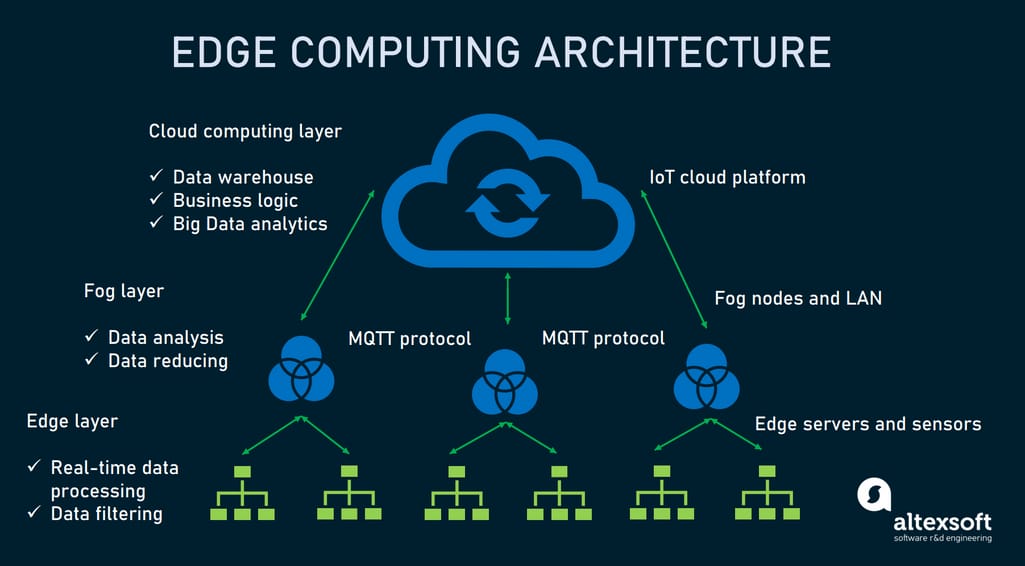
The Hierarchy of Edge
- The Device Edge: This is the sensor or device itself, like a smart camera or drone. It has limited power but no delay.
- The Gateway Edge: This is a router or small server on site, such as the server in the back of a retail store. It collects data from many devices.
- The Network Edge (MEC): Multi-access Edge Computing uses servers at cell towers or 5G base stations. These servers provide strong computing power just one step away from the device.
Hardware Accelerators
General-purpose CPUs are often too slow or generate too much heat for Edge AI. In 2026, we see the rise o these alternatives:f:
- TPUs and NPUs: Specialized chips (like Google's Coral or NVIDIA Jetson) designed solely to run AI inference.
- FPGAs: These are programmable hardware chips that can be quickly reconfigured for specific industrial jobs.
Part 10: Challenges – The Dark Side of the Edge
No technology is perfect. As we adopt Edge computing, we face new challenges.
Security and Physical Access
A cloud data center is like a fortress, protected by biometrics and security guards. An Edge devic, might just be a box on a telephone pole or a server in a busy store, making it easy to access. Hackers could plug into it or even steal it. The answer is to useZero Trust" architecture and hardware-based encryption (TPM chips). Devices should be built to shut down and become unusable if someone tampers with the.m.
Management Complexity
It is simple to manage one cloud server. But handling 10,000 Edge nodes spread across 500 cities is extremely difficult. That is why Edge Orchestration platforms now exist, letting IT teams update software on thousands of devices at once, similar to updating apps on a smartphone.
Conclusion: The Distributed Future
The era of centralization in the 2010s is over. The 2020s are all about distributed intelligence. Whether you’re improving a supply chain, creating a new healthcare app, or building smart city systems, knowing about Edge computing use cases is essential for reaching the next level of performance.
We are heading toward a world where the internet is not just something we use on a screen, but an invisible, smart layer all around us. It will anticipate our needs and protect us in real time. Edge computing is not just about speed; it is about making technology seamless, invisible, and much more powerful.
Are you ready to transform your business? To find out how to use these technologies, check out the resources at Digital Services Hub for expert advice on digital transformation. For the latest news on hardware and implementation, trusted sources like TechCrunch and Wired are must-reads for today’s technology leaders.
M